

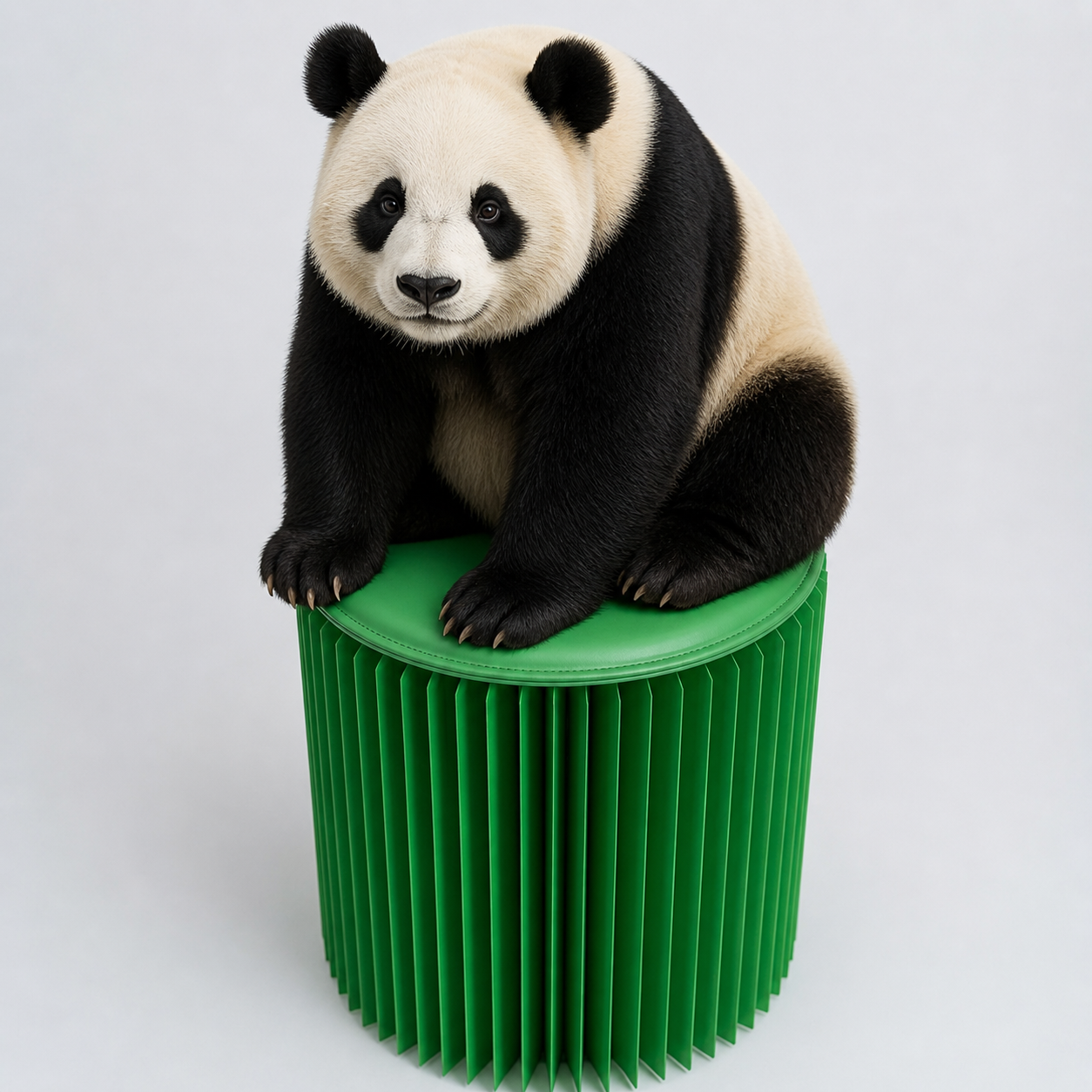
Most people pause before they sit. You see it at trade shows. A small flinch as they lower onto a stool, half expecting the thing to fold under them. Then it holds, they sit, and the conversation goes the same way every time. “It’s actually solid.”
That hesitation is fair. Paper, in most contexts, is fragile. You wouldn’t trust a paper plate to carry a curry across the kitchen, let alone a fully grown human. So when the spec sheet says a Paper Lounge stool will hold 100kg without flinching, scepticism is the rational starting point.
This piece is here to settle that. Not with marketing language, but with the engineering behind the claim, the testing each piece goes through, and the actual situations where these stools, benches and tables get used.
The quick version, at a glance
Before the long answer, here is the short one.
|
Spec |
Answer |
|---|---|
|
Maximum weight capacity |
100kg per stool, up to 350kg per bench, evenly distributed static load |
|
Where it works |
Indoors, dry environments only |
|
Materials |
Engineered Kraft paper with a hexagonal honeycomb core |
|
Foldability |
Concertina design, opens and folds flat in seconds |
|
Recyclable |
Yes, fully recyclable at kerbside paper collection |
|
Delivery |
Free UK delivery, ships internationally |
|
Returns |
30 days on unused items |
What the 100kg figure actually means
The 100kg rating is the maximum static load each stool is engineered to take. Benches sit higher again, up to 350kg, which is where the maths gets interesting.
For context, the average adult in the UK weighs around 78kg, based on figures from the Health Survey for England. So a stool sits comfortably above that, with a meaningful margin built in for movement, leaning, and the inevitable thud of someone dropping into the seat without ceremony.
It's also worth being clear about how the ratings work. 100kg is per stool, not per square inch. A bench seating two adults at 70kg each? Well inside its 350kg limit. A stool at the kitchen island, a table holding shopping bags and laptops, foot stools doubling as side tables. None of these are anywhere near the structural ceiling unless you're stacking dumbbells deliberately.
Why paper holds 100kg: the honeycomb story
The strength has nothing to do with the paper itself. It’s the geometry.
Inside every Paper Lounge product is a honeycomb structure. Hexagonal cells, packed tight, running floor to seat. The same shape bees evolved to use for storing honey, because hexagons enclose the most space using the least material. Six walls instead of four, and the angles brace each other against compression.
Aerospace engineers worked this out properly in the 1940s. The wings of most commercial aircraft contain honeycomb panels. Formula 1 monocoques use them. Satellite components use them. The reason is always the same. Stiffness-per-kilo is unbeatable. A honeycomb core is roughly fifty times stiffer per unit of weight than a solid sheet of the same material.
Now apply that to paper. Kraft paper is already strong in tension. It’s the same material grocery bags are made of, scaled up and engineered. Layer it into a hexagonal honeycomb, sandwich the cells between two flat sheets, and the whole thing becomes incredibly resistant to compression. Pressure on the seat doesn’t push down through the paper. It distributes across thousands of tiny vertical walls, each one taking a fraction of the load.
That’s what you’re sitting on. Not paper. An engineered cellular structure that happens to be made of paper.
What the testing actually involves
Every product is stress tested before it leaves the warehouse. The protocol breaks down into five parts:
-
Static load test. 100kg placed on the seating surface and held for sixty seconds. No deformation, no creasing, no give. Pass-fail.
-
Repeated cycle test. Loading and unloading dozens of times to mimic a single day of event use, where people sit and stand all day long.
-
Lateral pressure test. Force applied to the side of stools to confirm they stay upright on uneven floors and slightly slanted marquee bases.
-
Edge loading test. For benches in particular, where users perch on a corner rather than the centre.
-
Overnight load test. 25kg held overnight to confirm there’s no creep in the structure under sustained weight.
Where these things actually get used
Specs matter. Real world use matters more.
In retail, brands use our concertina stools and benches for pop-up activations and visual merchandising. Footfall in a busy shop runs into the thousands every day. The stools take repeated sitting, leaning and reshuffling without complaint, then fold flat at the end of the campaign.
In offices, creative teams kit out their breakout areas with our benches and tables expecting a six-month temporary fix. The temporary fix usually outlasts that. Same benches, same tables, daily use from coffee mugs, laptop bags and people perching cross-legged through video calls.
In homes, the pattern is different but the result is the same. Customers pull a stool out for dinner parties, then push it back flat against the wall for the rest of the week. Buyers tell us their teenagers have used the same Diablo stool through years of homework. The stool weighs little more than a hardback book. It is still standing.
Where the limits actually are
Now the honest bit. Paper furniture is not indestructible, and pretending otherwise would be insulting. Three rules apply, and they’re all about respecting the material rather than abusing it:
-
Keep them dry. The honeycomb relies on the integrity of its cell walls. Soak the walls and they soften. So everything we make is indoor only. Don’t park a stool in a damp shed. Don’t use one as garden furniture. Don’t seat guests on benches in a marquee that’s letting rain in.
-
Sit, don't stand. Sitting normally distributes weight across the seat. Standing on a stool with one foot, all your bodyweight pushed through a single contact point, is asking more of the material than it was designed for. It can usually take it. It shouldn't have to. For surfaces that see heavy daily use, a felt or plastic top sits flush on the seat and takes the wear that would otherwise land on the paper. Worth the few extra pounds if you want to stretch the lifespan further.
-
Pick them up, don’t drag them. The base of every piece is reinforced, but repeated dragging across rough concrete will eventually wear through the underside. Lift them when you move them. They weigh almost nothing.
Stick to those three rules and the structure will outlast most flat-pack furniture.
Why the 100kg claim matters for first-time buyers
If you have never bought paper furniture before, the trust gap is real. You can’t pick a stool up in a shop. You can’t run a hand across the surface and get a feel for the weight. You are being asked to take the strength on faith, and that is a lot to ask online.
The 100kg figure is not a number plucked out of the air. It is a tested, repeated, verified static load capacity. Used inside, kept dry, treated like furniture rather than gym equipment, our products will hold any adult comfortably for years.
If you want to dig further into care, longevity and the situations where paper furniture genuinely doesn’t fit, the FAQs cover the questions we get asked most often.
How paper furniture compares to traditional alternatives
On the headline metric, weight capacity, paper trails solid wood by a small margin. On every other metric that matters for modern flexible spaces, the comparison shifts:
|
Factor |
Paper Lounge |
Solid wood or MDF equivalent |
|---|---|---|
|
Weight capacity |
100kg per piece |
Often 110-150kg, depending on build |
|
Weight per piece |
Light enough to carry one-handed |
Heavy, awkward to move |
|
Foldable |
Yes, concertina, flat against a wall |
No, fixed footprint |
|
Indoor or outdoor |
Indoor only |
Some outdoor variants |
|
Storage footprint |
Flat, slides under a sofa |
Full footprint year round |
|
Carbon footprint |
Low, no plastic core, no resin binders |
Higher, especially MDF and treated woods |
|
End of life |
Recyclable as paper |
Often landfill or specialist disposal |
If you only ever need furniture in a fixed spot, with no transport involved and no storage pressure, traditional builds still win on raw capacity. The moment you need to move it, store it, ship it across the country, or eventually recycle it, paper rewrites the maths.
A short note on what paper furniture isn’t
This is not disposable. It is not the throwaway stuff you would put on a market stall and bin at the end of the weekend. It is engineered, tested, and built to be used.
It is also not right for every situation. Outdoor use is out. Bathrooms are out. Anywhere likely to take a sustained soaking is out. We would rather you knew that than buy a piece and feel let down a fortnight in.
Everywhere else, the question stops being “is paper furniture actually strong” and becomes “why isn’t more furniture made this way.” Lighter than wood. Foldable. Recyclable. A fraction of the carbon footprint of MDF or steel. The strength was the hard problem. Honeycomb solved it sixty years ago. We just made it sit-on-able.
Try one. The first time you lower your full bodyweight onto something that weighs less than a kettle and feels like it shouldn’t hold, you get it.
Share:
Interior Design Trends You Need To Know For 2025
Indoor Wedding Seating That Looks Great and Packs Flat