

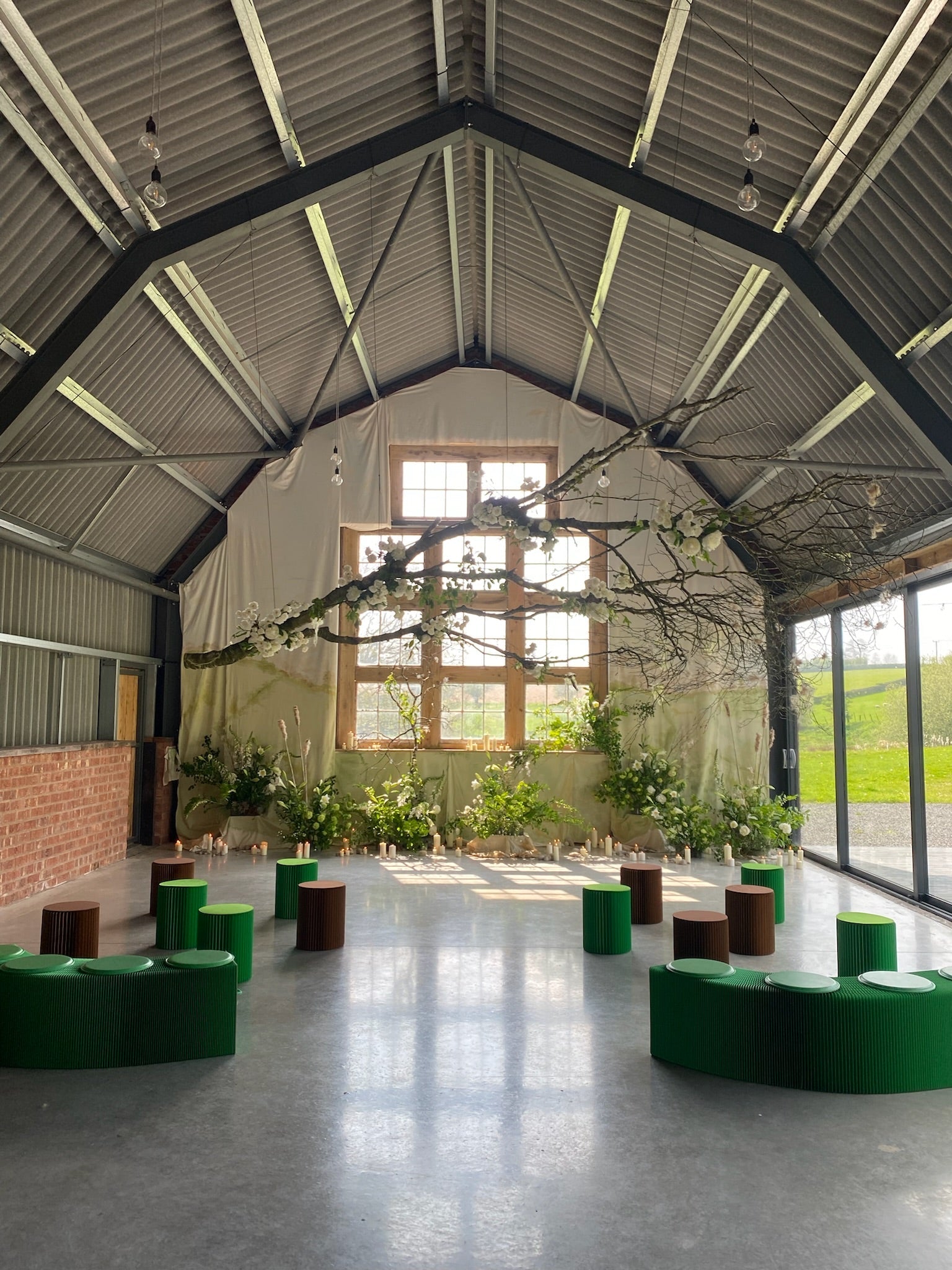
The supplier van pulls up at 9am. Two people spend forty minutes wheeling identical metal banqueting chairs across gravel, scuffing the legs against the venue door, stacking them in lines so straight they could be a train station waiting room. Photogenic? Not really. Sustainable? Definitely not. Quick to reconfigure when the room turns over from ceremony to dinner? Only if you've booked extra crew.
Hired seating is the part of the wedding day nobody really talks about until the morning after, when the van comes to collect every chair you spent £600 on and you're left with the bill, not the furniture. There's a quieter alternative coming through, and it's been hiding in art galleries, pop-up shops and design studios for the last few years. Foldable Kraft paper furniture. Specifically, the kind made from concertina honeycomb that's rated to 100kg per seat position, sets up in seconds, and packs down to roughly the depth of a hardback book.
This guide walks through how to use it for an indoor wedding. Styled setups, seating plans for typical guest counts, and the real maths of buying versus hiring.

Why hired chairs are the default and what they actually cost
Walk into any UK wedding venue and you'll see the same three options. Hire prices run roughly £3 to £8 per chair plus VAT and delivery, with most suppliers offering volume discounts above 50 or 100 chairs. For 120 guests you're looking at £400 to £900 on seating alone, before linen, delivery, or the return collection fee.
|
Chair type |
Hire per chair |
Reads as |
|
Chiavari (white, gold, limewash) |
£4 to £8 |
Polished, classical, ballroom |
|
Cross-back / farmhouse |
£4 to £7 |
Rustic, barn, country |
|
Banquet with ribbon-tie cover |
£3 to £5 |
Traditional, hotel, formal |
There's nothing wrong with any of those chairs. They look smart. The issue isn't the chair, it's the model. Once they arrive, they're yours for the day and then they're gone. Want to convert the ceremony space into a dancefloor in 45 minutes? Hope you booked an extra crew. Decided you want a lounge corner for the older guests during the band? You're stacking chairs in a corridor.
Then there's the look. Wedding aesthetics have shifted hard toward editorial styling, neutral palettes and tactile materials.
What flat-pack Kraft furniture actually is
The Paper Lounge stools, benches and tables are made from layered Kraft paper formed into a honeycomb structure. Open one out and it locks into a stable, weight-bearing piece of furniture. Each takes about three seconds to set up. Done with it? Push it back together and it folds to roughly 5 to 8cm thick, depending on the model.
Capacity is the bit that catches most people off guard. Stools and benches are rated to 100kg per seat position. They're not novelty pieces. They're indoor only, which matters for weddings, anything outdoors needs different planning.
The texture is the other selling point that doesn't translate well in spec sheets. Up close, the honeycomb edges catch the light. From across a room, the silhouette is clean and minimal. They photograph well under warm tungsten and don't bounce flash like polished metal does, which photographers tend to appreciate.

Styled setups that actually work
A few configurations that have held up across real events:
The minimal ceremony
Two clean rows of benches facing the aisle, six guests per bench, total seating for around 80. Greenery strung along the bench fronts in low garlands rather than tall arches. The honeycomb texture reads as warm and natural against white walls or exposed brick. Works particularly well in converted barns, gallery spaces and any venue where the architecture is already doing some of the visual work.
The reception lounge zone
A cluster of three or four stools around a low Kraft paper table. Throw down a sheepskin or a flatweave rug underneath. Add a single floor lamp with a warm bulb. This becomes the spot where the parents end up, where the photos that don't feel posed get taken, and where the dancefloor refugees retreat at midnight.
The mixed seating plan
Dispenses with the strict everyone-on-identical-chairs rule. Long Kraft benches down the sides of a banquet table, individual stools at the ends, maybe a couple of upholstered armchairs at the head for the couple. Reads as designed rather than rented. Doesn't fight with the table styling. Costs less than full chair hire for the same headcount.
The cocktail hour standing-and-perching mix
Stools scattered around the room rather than rows of chairs. Guests circulate, perch, talk, move on. Fewer dead corners, more actual mingling. Kraft pillars at chest height work as drink stations or floral plinths. The whole space becomes more usable than it would be with traditional banqueting layout.
The kids' table
Low stools, low table, off to one side with a colouring station. The kids get something proportioned for them.
Seating plans for typical guest counts
Some rough numbers to work from. These assume an indoor venue with reasonable floor space and a mix of ceremony, reception and evening guests.
|
Guests |
Benches |
Stools |
Tables |
Flat-pack volume |
|
60 |
12 |
12 to 15 |
— |
Two suitcases |
|
100 |
18 to 20 |
25 |
— |
Boot of a mid-size estate car |
|
150 |
25 |
35 to 40 |
6 to 8 |
A small van, well under hired-chair volume |
For the 60-guest setup, the benches do double duty: two rows of six during the ceremony, reconfigured into long banquet seating for the meal. The 100-guest plan keeps benches on ceremony and dinner, with stools covering lounge zones, the bar area and any kids' setup. The 150-guest plan starts to fill a small van but you're still nowhere near what 150 hired Chiavari chairs and trestle tables would take, and you're not running a return collection at midnight.
These plans also account for the fact people don't sit down for the entire wedding. Allow for around 70 to 80% of your guest count in actual seating positions if you're doing a mix of formal dinner and standing reception. Anyone planning a rigid one-seat-per-guest for the whole day usually ends up with too many empty chairs in the photos.
The honest maths of buying versus hiring
|
100 seats compared |
Hired Chiavari chairs |
Flat-pack Kraft stools |
|
Transport footprint |
Bulky stacks, small pallet |
Stacks flat, splits across boot loads |
|
Vehicle to move them |
Luton van plus pallet truck |
Estate car or SUV |
|
Delivery model |
Delivery plus next-day collection |
Self-collect or single drop |
|
After the day |
Returnable, you have nothing |
Yours to use, lend or resell |
For couples
The benches don't go in the skip on Monday morning. They fold flat into a wardrobe and come out for the housewarming, the first anniversary, the christening, the summer garden party (under cover). Three or four events that don't need separate seating hire. Per-event cost drops with every reuse.
For wedding planners
Twenty stools bought outright, used across ten weddings in a year, sit at roughly £30 per event by the second year. Hire over the same number of events runs into thousands. Storage is a wardrobe rather than a warehouse. Setup is seconds per piece instead of waiting for a two-hour delivery slot.
For venues
In-house stock removes the delivery scheduling, the damage charges, and the return collection eating into Sunday morning. A hundred stools fits in a cupboard the size of a domestic wardrobe. Try that with stacking chairs.
Built for more than one day
Kraft paper pieces don't have to retire after the wedding. Fold them flat, stack them in a cupboard, and they're ready to come back out for the next birthday, christening or summer party. The more often each piece earns its place, the further the original day cost falls.

What to know before you order
A few practical points worth flagging:
-
Indoor only. Kraft paper handles indoor humidity fine but isn't built for direct rain or wet grass. If your day has any outdoor element, plan separate seating for that section or have a clear weather contingency.
-
Weight capacity is generous but not infinite. The 100kg figure is per stool or bench seat position. A bench fits two adults comfortably, three at a squeeze. Don't ask three rugby-sized guests to pile onto one, that's not what it's designed for, and the same is true of any wood or metal bench.
-
Lead times tighten in summer. May through September is the busiest window for wedding orders. The earlier the better, especially for the recycled collection.
-
Spills happen. Kraft paper has a degree of natural resistance but isn't waterproof. If a guest knocks over a full glass of red, blot it fast. Most marks lift with light dabbing. Anything that needs more than that, mark it as a cocktail-hour casualty and move on.
How to put it together for your day
The starting point is usually the Paper Lounge events page, which covers the core options for weddings, exhibitions and corporate events. From there, the wedding-specific solutions walk through how the seating tends to be configured for ceremony, dinner and evening sections.
The pattern most couples and planners follow:
-
Lock in a rough headcount and the rooms you're seating across (ceremony, dinner, evening).
-
Pick a primary mix. Most weddings land on benches plus a smaller stool cluster for the lounge zones.
-
Browse the bench and stool collections and sketch the layout against your venue's floor plan.
-
Order four to six weeks ahead if you're in the May to September peak.
-
Set up on the morning of the day. Three seconds per piece, no crew needed.
-
Pack flat at the end and load into a single car.
Flat-pack Kraft seating doesn't replace every other option. It handles the parts hired chairs don't. The lounge zones, the fast turnover from ceremony to reception, the kids' corner, the styled photo moment. It packs home in a single car at the end of the night. And unlike hire, you still have it on Monday morning.
Share:
Is Paper Furniture Actually Strong? Putting the 100kg Claim to the Test
The Real Environmental Cost of Event Furniture and the Alternatives Worth Knowing